Wednesday, February 13, 2013

Be Mine . . . Or Not

Tomorrow is Valentine's Day here in the States. I don't celebrate it. Don't get me wrong—I like flowers and chocolate as much as anyone—but it is a holiday that, for kids, might as well be called Self-Esteem-Busting Day.

I'd like to say that I don't celebrate it because of its dark origins. I even tried to give it a different spin by calling it יום אהבה (Yom Ahavah), or Day of Love. No luck. Those little candy hearts rose up from my subconscious and left a sickly sweet taste in my memory.

The truth is that it was a big thing in my elementary school. Everyone in class was supposed to bring little Valentine's Day cards for every classmate. Candy was optional, but extremely valuable.
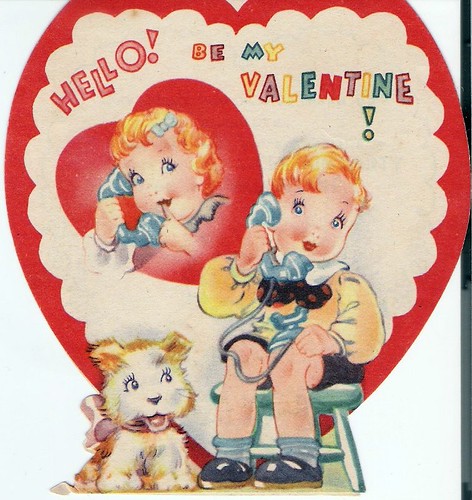
Valentines Day Cards by Mark Gstohl, on Flickr 
This meant a trip to the store to buy a box of cards, plus some candy, because giving out candy was a sure way to earn a few points on the social acceptability index. And then each card had to be handwritten with "To" and "From" names. Thirty-one kids. And a big one for the teacher. For much of my early elementary school career, this was an expense my family couldn't afford. 

Then came the moment of truth: we had a time during class for handing out valentines. Everyone got up and moved around the classroom, distributing valentines as covertly as possible. Because even though the idea was that everyone would exchange valentines, that never actually happened. Many kids only brought valentines for their friends and the popular kids in class. (Hint: I wasn't one.) So, after distributing 31 cards, it was common for some of us to come back to our desks to find that we had maybe four cards from other classmates.

Valentine's Day had become a popularity contest. The kids who received all 31 were not shy about sharing this fact. Those of us who had fewer than ten were shamed into silence. And it didn't matter that we'd brought candy.

Fast forward some . . . well, a lot . . . of years. I'm an adult now. I don't have to give cheap cards to all my friends in the hopes that it will be reciprocated and I won't be branded a social pariah for the next week or so until the next popularity contest comes along. I don't have to try to buy my way into peer acceptance. But I still don't like Valentine's Day. 

It's big business now. Tens of billions of dollars are spent on cards and gifts. For adults, it's no longer a popularity contest; it's now a love test. "If you give me chocolate/flowers/card/jewelry, then that means you love me. If you don't . . ." 

How much heart-shaped jewelry does a woman need? And why, oh why, does it have to be on one arbitrary day a year?

Valentine's Day is too contrived. It seems like a setup to fail. "Only one rose, dear? But last year you gave me a dozen, and a diamond heart necklace." "What do you mean, you forgot Valentine's Day? Don't you love me?" "I have to figure out what to get my [significant other] for Valentine's Day, and my credit card is maxed out."

How about this? This is my answer to Valentine's Day. I don't celebrate it. I try not to even acknowledge it, except for the occasional blog rant. But what I do is make it a point to tell those I love that I love them. Every day. I tell them that appreciate them. I value their presence in my life. I try to do nice things for my husband just because.

That's what we need: not a Valentine's Day. Not a Yom Ahavah. We need a Just Because Day—every day.

Wednesday, November 28, 2012

On Disabilities and Excellence

Excuses, excuses, excuses. I can still hear my mom chiding me for trying desperately (and often to no avail) to explain my side of any particular story. Growing up, there were no legitimate excuses. There were bad excuses (I overslept; he hit me first), worse excuses (I don't feel like it; my brain is too full from math to remember what you told me), and excuses of character (he sponges off everyone and can't hold down a job; she must think money grows on trees). None of these excuses ever invited compassion.

And so it seems natural that I have the hardest time accepting my own excuses now. There's no justification for mediocrity, unless one is only capable of mediocrity. That's a low blow, isn't it?

So what if your elbow is broken or you have a migraine or you're just getting over pneumonia? You can do better. I know it, you know it, and your teacher/boss/[insert other important authority figure here] knows it. You can do whatever you set your mind to do. (Did you realize this empowering statement has a sharp edge?)

We are a society that values individuals who pull themselves up by the figurative bootstraps, who invent and innovate and create jobs, who are the hardworking backbone of America's legacy. We do not approve of slackers and leeches and people who take without giving back. But has that gone too far?

What if . . . what if there really were legitimate reasons for having good days and bad days? What if we can expect excellence, but not always consistently? What if there were reasons that took into consideration that we are complex human beings with emotions and competing obligations and bodies that can break—and break down?

In the Talmud (Pirke Avot 2:21), Rabbi Tarfon reminds us that we are expected to show up and do what we can. We're not expected to be perfect. We're not expected to be consistently excellent. We're not expected to finish the task. Do what you can. And that's not looking at a per-task basis, either. That's looking at life. Show up in your life. Show up in others' lives. Do what you can.

I'm not real open about it, in part because I am well aware of the associated stigmas, but I have multiple disabilities. I have battled severe clinical depression since my early teens. I have obsessive compulsive disorder (OCD), which is both a blessing and a curse. I have frequent panic attacks. And I have fibromyalgia. There are a few other things (PTSD, sleep apnea, prediabetes), but these are the biggies. Somehow, in the chemically complex recesses of my brain, these are all connected. I was apparently taking a brain break out on the playground when G-d was giving most everyone else their share of seratonin.

All this means I have good days and bad days and then a few really, really bad days. The question is: on the really, really bad days, is it reasonable to still expect excellence? To some, this is a no-brainer. But when your world view doesn't allow for excuses, really really bad days are just another obstacle to overcome. And really, how bad can they be? When there are people in the world who are starving, homeless, fearing for their lives, living in the midst of violence and torture, what's a little depression or body pain?

Except that pain is pain. We can't fully appreciate another's pain unless we experience it exactly as they do. But we can be compassionate and understanding and patient. We can show up and do what we can. We can help by donating food, giving tzedakah, voting for human rights, buying fair trade chocolate, supporting small businesses, smiling at a stranger, being kind with our words whether they be said aloud or typed on a keyboard.

Yesterday was one of my really bad days (but not a really really bad day). My body felt like I had the flu (body aches) without a fever. I was struggling to stay awake; moving my limbs was as difficult as trying to lift weights in a second set immediately after "going to failure" on the first set. I literally could not think. Studies have shown that people with fibromyalgia have four times the body's natural pain-relieving chemicals in their bloodstream. That's like trying to function while under morphine. No wonder I can't think.

I'm trying the best I can. Really. I know that sounds like a bad excuse. I expect more of myself. I expect excellence consistently. And I'm going to be disappointed, because life is telling me it just isn't possible. It's not an excuse. It's reality. Maybe if I just focus on showing up and doing what I can . . . .

Wednesday, August 15, 2012

Jewish Book Carnival - August edition

For those who don't know, there's a Jewish Book Carnival in the blogosphere, and this month it's hosted by Needle in the Bookstacks, a blog from the HUC-JIR librarians (go librarians!). Please check out the August Jewish Book Carnival post there and support Jewish books.

Monday, August 13, 2012

Eema, What's Your Career?


"Eema, what's your career?" my younger son (age 9) asked on the way home from summer camp. 

I decided quickly to turn the question back on him, hoping for either a teachable moment or an entertaining answer. "What do you think I do?" I asked. 

"I know you make books," Younger Son said.

"She publishes books," my older son (age 11) corrected him. "And you've written, what, three books too?"

"I've finished two," I said. "And I've started a third." I glanced in the rear-view mirror at my younger son. "Why do you think I chose this career?" I asked him.

Older Son took the opportunity to answer for his younger brother. "Well, I know you started your business so you could be home with us."

"And you really like books," Younger Son added.

"I do like books," I said. "Why do you suppose I wanted to only write and publish Jewish books?"

Younger Son had an answer first this time. "Maybe because that's all you know how to do?"

"No," Older Son corrected him again. "She has lots of degrees. She could write books about all sorts of things." He leaned forward in his seat. "I think it's because you like being Jewish."

"That's pretty much it. Being Jewish is the core of my identity. It helps me understand who I am and why I'm here. And I wanted to give something back to Judaism. Why not meld my two biggest loves: books and being Jewish?"

Younger Son gasped melodramatically. "I thought we were your biggest loves!"

"Okay, my biggest non-people loves."

"And also," Older Son said, "I think it's because you know that Judaism is important for people to know about, what being Jewish really is, and it needs to be displayed more openly so people can learn about it."

I could only smile and shake my head as I drove. Mission accomplished. This time it was Older Son teaching me.

Thursday, July 26, 2012

Life's Too Short

I was nowhere to be found
Locked up so tight never making a sound
The answer stuck in my head
A thousand words always thought never said
Gonna make it clear, this is me here, gonna let it go


—Marie Wilson, Making It Up As I Go Along, 1999.

I just scheduled my next haircut and noticed we're less than eight weeks from Rosh Hashanah. *sigh* I have really neglected my blog, my Facebook author page, my writing. And at the same time, I've been working full-time this past year, publishing other authors' books.

And that's where I was comfortable. Safe. Behind the scenes, working my magic, away from the spotlight. Sure, I had my opinions—strong ones at that—but I feared expressing them. I feared the Beat Down.

You know what I've learned? Decisions based on fear are rarely wise.

I went to a women's gathering once, a few years ago, despite my very introverted tendencies. I was trying to stretch my comfort zone, which, I'm told, is a good thing. I was very self-conscious, and for anyone who knows me personally, being self-conscious means that I rarely—and barely—speak.

At the gathering, we all were to have a large group discussion about our relationship to Conservative Judaism. Some women spoke extensively; others passed. I spoke briefly about generally identifying as Conservative, but sometimes finding myself drawn to both Reform and feminist Orthodoxy.

The woman who spoke after me looked directly at me and prefaced her discussion comments with, “Without taking thirty sentences to answer…”

Okay, first? Rude. No one called her on it. I was insulted. Second, I used maybe five sentences, and I certainly wasn't the most talkative in that discussion. And third, and saddest, I never went to another get-together with that group. There was no question her comment was directed at me. It was the Beat Down. And she won, for a while.

I refrained from blogging, or posting anything potentially controversial on Facebook, because I was expecting another Beat Down. And it's taken me nearly forty-four years to realize that this fear is a universal one. And life's too short to let the beaters like that woman win any more. It's time to speak up.

Monday, September 12, 2011

Faceshuk

Admin stuff. You can ignore this!


456178caaa2c440744f402e9c190d265

Shame as a sin

We have all felt shame. It's a universal emotion. It's also something of a taboo. No one wants to talk about it because we all know what it feels like, and it's just . . . icky. It can make us feel worthless, stupid, ugly, judged.

The thing about shame is that it makes us feel bad about who we are, not what we've done (or not done). During this month of Elul, in preparation for Rosh Hashanah and Yom Kippur, we're encouraged to look over the past year and take a kind of inventory. What would we do differently? To whom do we owe amends? How can we change our behavior and choices in the next year?

But shame is different. Shame doesn't say, "You made some mistakes and you can make teshuvah (literally "return," but also repentance) and apologize and make changes so you don't make those mistakes again." No. Shame says, "You suck, and there's nothing you can do about it."

Our machzorim--High Holy Day prayerbooks--talk about mistakes and sins and a myriad of things we do that we know we shouldn't do but we do them anyway. 

I'd like to propose that allowing shame to dictate our self-worth is also a sin.

I'm reading this book called I Thought It Was Just Me (but it isn't) by Brene Brown, Ph.D. It's about shame and perfectionism and personal power. It defines shame (p. 5) as "the intensely painful feeling or experience of believing we are flawed and therefore unworthy of acceptance and belonging."

We are all created b'tselem Elokim--in the image of G-d. If we believe ourselves, images of G-d, to be unworthy of love and acceptance and belonging, then we diminish G-d. Remember that old quip, "G-d don't make no junk"?

This goes back to what I wrote about yesterday, struggling with how much to say, how open to be. Because underneath it all is the fear, "If people knew the truth about me, they wouldn't like me anymore. They wouldn't respect me or read anything I write. I would be a failure." And if I say too much here on the blog, well then, maybe people would figure out that what my shame is telling me is true.

Says Dr. Brown, "Shame forces us to put so much value on what other people think that we lose ourselves in the process of trying to meet everyone else's expectations."

If we lose ourselves, do we also lose G-d?

In the Torah, we're told, "You shall not take vengeance nor bear any grudge against the children of your people, but you shall love your neighbor as yourself; I am the L-rd." (Vayikra [Leviticus] 19:18) Would not believing oneself worthless and undeserving be equivalent to bearing a grudge--against yourself?

Further, if we do not love ourselves, then how can we possibly love anyone else? Because obviously it makes no sense to treat others with the same disdain and disgust with which we treat ourselves when we feel shame. We are not told to hate others as we hate ourselves. We are told to love. That makes (appropriate) love of oneself a mitzvah, a commandment. (Remember, we're not talking about self-aggrandizement here--we're talking about shame. If anything, shame can lead to self-harm.)

Encouraging people to take stock of their lives at this time of year is a given. Guilt is practically expected. But how do you guard against shame?

Perhaps I'll have more answers when I finish this book.